

The erg sits ready. The monitor glares back at you. Two thousand meters stand between you and a new personal record—a number that feels like it holds the key to your future. If you’re a student-athlete in the world of rowing, you know this pressure intimately. The 2K test and the college recruiting process can feel like two immense forces converging on you, creating a storm of anxiety and self-doubt.
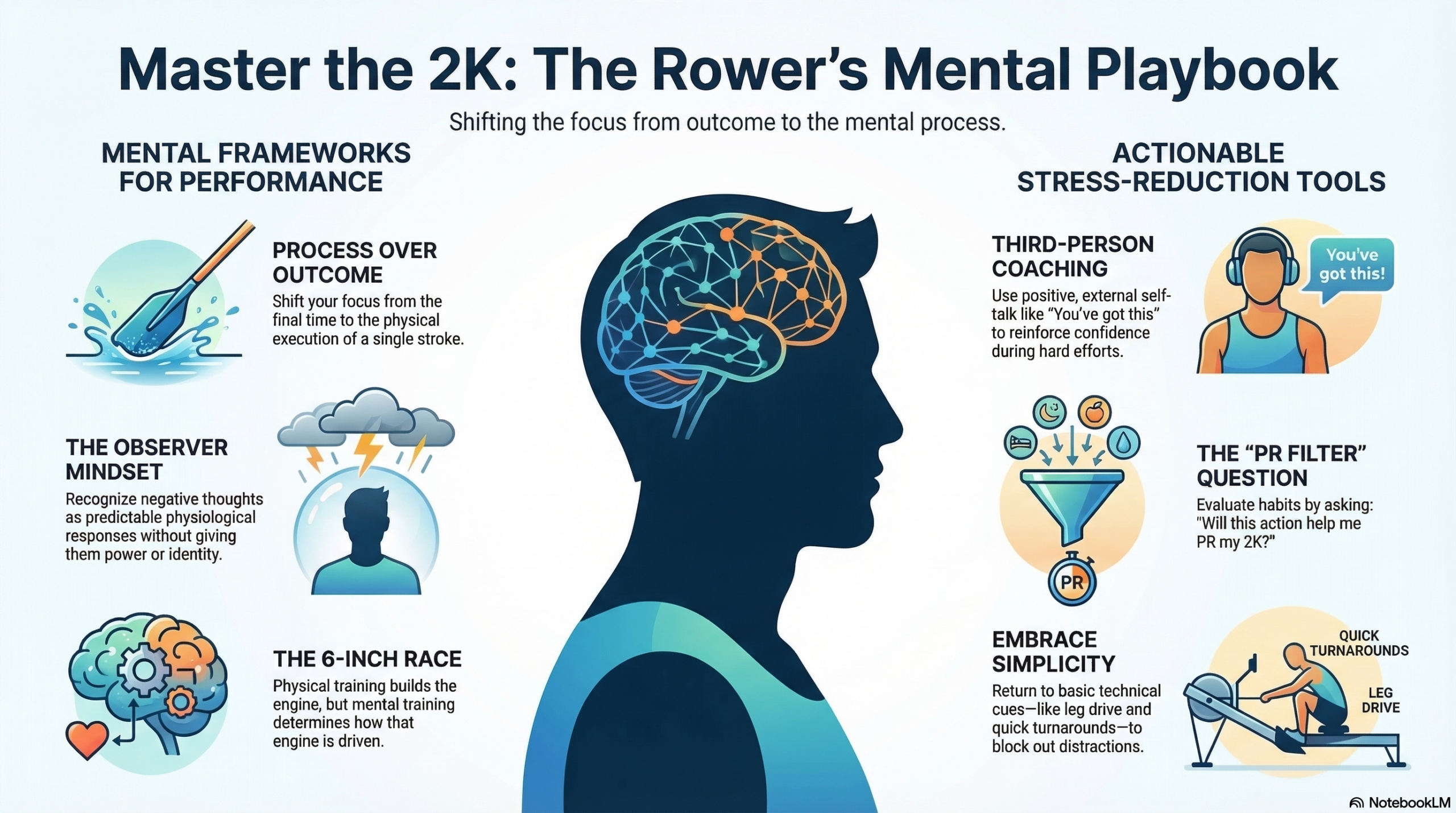
But what if I told you that the greatest race you’ll ever win isn’t on the water or the erg? It’s within the six inches between your ears. Your physical training has built a powerful engine; now it’s time to train the driver.
Many athletes I’ve worked with have incredible physical capabilities, but they get tripped up by mental hurdles. The pressure to perform for college coaches can turn a simple test of fitness into a monumental source of stress. The solution isn’t to pull harder, but to think smarter. It’s about shifting your focus from the outcome—the final time on the monitor—to the process of creating that time, one stroke at a time.
Here are the strategies that will empower you to take control of your mental game and unlock your true potential.
Embrace Simplicity and Stay Present
As you get faster and college coaches start noticing you, the simple act of rowing can become complicated. Suddenly, every workout, and especially every erg test, feels like an audition. This added pressure is a distraction that can hinder your progress.
Your first step is to return to the basics. Remember why you started rowing in the first place. Focus on the feeling of quick turnaround at the front end, powerful leg drive, and a smooth finish. The key is to stay in the present moment. During a 2K, your mind shouldn’t be on the final 500 meters when you’re only at the start. It should be on this stroke. And then the next one. Maintain a consistent stroke rate and a calculated effort. Don’t get lost in complex strategies; just row your race, one stroke at a time.
Become the Observer of Your Thoughts
When you’re pushing your body to its absolute limit, your mind will inevitably start to protest. Thoughts of doubt and anxiety are not a sign of weakness; they are a normal response to a difficult task.
The trick is to learn how to recognize these thoughts without giving them power. Treat yourself as a third-party observer. When a negative thought like, “I can’t hold this split,” pops into your head, simply acknowledge it. See it, identify it as predictable, and let it pass by without latching onto it. You are not your thoughts. Acknowledging them is a signal that you are doing something challenging and worthwhile. It’s proof that you’re pushing your boundaries.
Coach Yourself to Victory
Once you can observe your thoughts, you can start to actively manage them. This is where positive self-talk and self-coaching become your secret weapons. Before and during every session, you have the power to direct your inner dialogue.
Instead of letting doubt creep in, proactively inject positive affirmations. Remind yourself of the work you’ve put in. Coach yourself in the third person: “You’ve got this. Settle in. Stay strong.” This isn’t just empty cheerleading; it’s a proven technique to reinforce your confidence and maintain focus when the work gets hard.
Ask the Ultimate Question
To keep your daily actions aligned with your biggest goals, use a simple filtering question: “Will this help me PR my 2K?”
Ask this about your training, your recovery, your nutrition, and your sleep. This simple question cuts through the noise and keeps you focused on the high-impact actions that truly move the needle. It transforms the overwhelming pressure of the 2k and recruiting into a clear, actionable plan.
The recruiting process doesn’t have to be a source of paralyzing stress. See it for what it is: an opportunity you’ve earned through hard work. The 2K is not a judgment on your worth; it’s a measure of your fitness on a single day. Your power lies in focusing on the process, managing your mind, and trusting the training you’ve done.