

Few words make a rower’s stomach drop like “we’re seat racing today.” There’s no hiding behind an erg score or a reputation. It’s you, the boat, and the margin.
Luke Walton puts the simple version this way: win seat races, don’t lose them. But as he and fellow Olympian Dan Walsh show in our latest Mettle Factory episode, there’s a lot of complexity under that simple idea. Dan raced at the World Championships until he was 34, was seat raced on port, starboard, and in sculling, and jokes that he may have won more seat races than anyone in America. Here’s what they shared, along with the basics every rower should know.
Watch: Dan Walsh and Luke Walton on How to Win a Seat Race
Press play first. This Rower Academy Mettle Factory conversation is told from the athlete’s point of view: what seat racing really measures, the mindset you need, the traps to avoid, and Luke’s step-by-step plan for winning a direct seat race.
Rowing Seat Racing | 2 Olympians Discuss How to Win | Mettle Factory. Watch on YouTube
What Is Seat Racing?
Seat racing is a selection method where coaches race two boats against each other, swap athletes between them across repeated pieces, and compare how the margin changes to see who helps a boat move faster.
World Rowing’s coaching material (FISA Coaching Development Programme, Level III, Crew Selection) describes it as an athlete competing directly with another athlete for a seat by switching from one boat to the other. Dan adds an important point: seat racing is an art more than a science, and there’s very little good information out there on how to run it well.
A typical session
To keep things simple, Dan and Luke use one example throughout the episode: two straight fours, rigged the same way, doing four 6-minute pieces, with rowers swapped seat for seat and side for side. Dan’s view is that a good seat race has as few variables as possible, and ideally every piece is rowed in the same direction so conditions stay similar.
World Rowing’s guidance agrees. It recommends shorter pieces (1000 m, 1500 m, or 3 to 5 minutes) instead of a full 2000 m, a rolling start where both crews build together on the starter’s call, a controlled stroke rate (often 30 to 34), matched and properly rigged boats, and no rigging changes during a session. Most sessions are capped at around five or six pieces so fatigue doesn’t distort the results.
The Four Ways a Seat Race Is Judged
Most rowers only think about their own swap. Luke and Dan explain that it’s only one part of the picture.
- Direct seat race. Two boats race and the margin is recorded. Then, for example, the two 3 seats swap, the boats race again, and a new margin is recorded. This is the one rowers “either love the most or dread the most.”
- Indirect seat race. You don’t move, but everyone around you does. Dan says this happens to the stroke seat about 90% of the time. By the end you may be stroking a completely different crew, so you’ve been seat raced without ever leaving your boat. His warning: thinking you aren’t being raced just because you haven’t been switched is one of the fastest ways to lose an indirect seat race.
- Cumulative margin. The total of your wins and losses over every piece. Luke’s key point is that you can lose a piece and still win the seat race. If your boat wins by four seats and you switch into the losing boat and lose by only two, you’ve won your seat race by two.
- Fastest lineup of the day. If one lineup is clearly faster than all the others, coaches have to take it seriously. Dan adds that it works the other way too. If you “win” a swap but both boats got slower, it barely counts. If you lose a swap but both boats posted their fastest times, you may still have won the day.
A fifth idea came up too: the “rubber match,” where you’re switched, switched back, and switched again to confirm a result. World Rowing’s guide recommends the same thing: switching two rowers back to check a margin.
Luke sums it up: “If you’re doing four pieces, they’re all the one.” Every piece counts, and you owe every crewmate the same effort no matter who’s being switched. Otherwise, as he puts it, “the experiment doesn’t work.”
The Seat Racing Mindset
Always be ready. Dan’s first rule: be ready to be seat raced, period. Hard days such as fall work pieces, spring starts, or 2k time trials are when seat races usually matter most, but you can be switched during steady state or drills too. Sometimes that’s a test, or even a trap. Will you go all out to win a steady-state switch and have nothing left for race day?
Believe you control your fate. For Dan, it all starts with agency: knowing that when you put more pressure on the blade, the boat speeds up, for you and for everyone around you. He says training on your own from YouTube videos alone “doesn’t really teach you to have agency over your fate.” That comes from time in a boat with a crew.
Be the teammate people want. Dan wants the other three in the boat to see the lineup and think, “Thank God Walton’s in our boat.” Being seen as a reliable boat mover sets you up for the whole day.
Don’t freeze. If you’re tense, biting your nails, and afraid of being switched, Dan says “you’re dead in the water.”
Think like a fighter. Dan, who also has a background in wrestling and combat sports, says seat racing is more like a fight than an endurance event: it’s you against the person you’re swapped with. He calls it a game of momentum, and says it’s harder to come from the winning boat and raise the energy of the losing boat than to join the winning boat and keep its energy going.
Hammer or nail? Luke’s question for every athlete: are you the one making the boat faster, or the one soaking up the other boat’s energy? Learning to be the hammer is essential. Dan adds a third option for rowers who get tested over and over: be the anvil, and show there’s no beating you can’t take.
Can You Avoid a Seat Race?
Luke asks this half as a joke, but his answer is serious: the best way to avoid a direct seat race is not to be a question mark. Training time is limited, so coaches spend seat racing on athletes they’re still unsure about. If you’re consistent and your bow ball is ahead in every lineup, you’re less likely to be raced.
Dan’s warning is that you’ll still get tested eventually, often at a bad moment. He remembers being seat raced right before racing season at Cal under Steve Gladstone. And a “glue player” who helps a boat’s chemistry can lose badly once they’re taken away from the strong rowers around them. As Dan puts it, if you don’t take risks in sport, you won’t be the athlete who wins it all.
Both agree that summer camps, U19 and U23 selection, and national team trials are different. Coaches are sorting out a whole group at once, so you’ll be in the rotation no matter what. Show up ready.
Pitfalls to Watch Out For
- Asking for a seat race. Dan’s warning: be careful what you wish for. Ask to race athlete C and the coach may pair you with athlete A. If you’re number nine fighting for an eight, be ready to race number one.
- Being the “hatchet man.” Luke describes how strong, consistent seat racers are sometimes used in big camps as the standard everyone is measured against, so coaches can cut the squad quickly.
- Going in run down. Luke points out that a tough winter, an injury, or an illness can leave you without the test scores to back you up, which makes seat racing the place where you have to prove yourself.
- The “JV hero.” Dan’s name for a rower who looks great stroking the second boat but is “varsity neutral” once promoted, either out of their depth or relaxed because they finally made it.
- Forgetting your own boat. If you think you’ll win your seat race, Dan says to make sure the boat you’re in is winning first. The best way to move up is to help the second boat steal pieces. “The only way out is through.”
Which Seat Has the Most Control?
The easy answer, Luke says, is the stern: stroke, 3 seat in a four, or 6 and 7 in an eight, because those seats control the rhythm and length of the boat. But he’s seen a 2 seat swap in an eight completely change the boat’s speed. His conclusion: where you sit matters less than what you do when the switch happens.
Dan thinks stroke is the hardest seat to switch out of. It’s very hard to join the winning boat at stroke and make it go faster, while the stroke of the losing boat has a fired-up crew behind them (“anger is a gift”). He sees bow pair as the easiest place to make a positive difference.
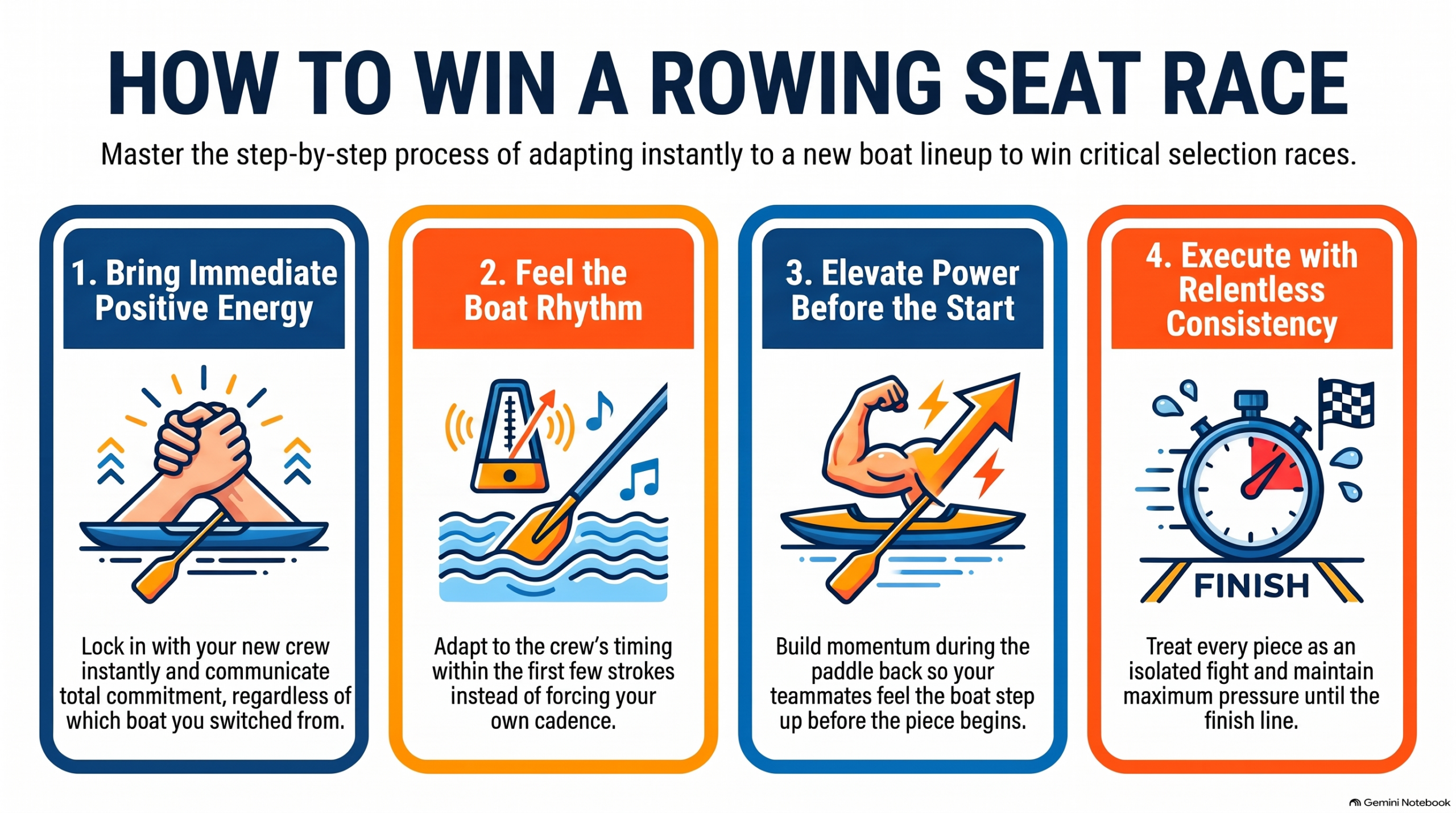
How to Win a Seat Race: Luke Walton’s Plan
At the end of the episode, Dan asks Luke for advice athletes can use today, or when the season starts in March. Here’s Luke’s plan for a direct seat race:
- Bring positive energy into the boat. Whether you’re coming from the winning boat or the losing one, tell your new crew you’re ready and locked in. From the winning boat: “We’ve got this.” From the losing boat: “I saw you guys win. I want us to win by more.”
- Feel the boat right away. Within a few strokes, figure out the rhythm of your new crew. That’s harder at U23s, where everyone comes from a different program, than on your own team.
- Then add power. Once you have the rhythm, lift the crew during the paddle back to the start, what Luke calls “steady state plus,” so they feel things stepping up before the piece even begins. Don’t wear yourself out doing it.
- Execute. Race the piece as well and as consistently as you can within that rhythm.
Dan finishes with his own plan. If you come from the winning boat, tell your new crew exactly where you beat them. If you come from the losing boat, ask where they beat you so you can do it again. Then go for the knockout. “It may only be a seat or a bow ball,” but once you have it, keep the other boat on the ropes, “and then if the other boat is on the ropes, be merciless.”
Two more tips from the episode
- Have a short memory. Luke: the pieces before and after don’t exist, only this one does. Losing the last piece by two seconds doesn’t mean you’ll lose the next. The first thing to say when you switch is, “What do you need?”
- Don’t slow the boat down first. The best seat racing advice shared in the episode comes from Chris Clark at Wisconsin: “figure out how not to slow the boat down first, then worry about making it go fast.” Fit into the crew’s rhythm before you try to add to it.
Limitations and Criticisms
Seat racing is best treated as one data point, not a perfect formula. Dan points out there’s no real manual for it and every team is different. Luke admits that reading the data correctly is “very tough,” especially once swaps involve different seats, sides, or pairs. Common problems include:
- Conditions: Wind and water change between pieces, especially when crews race in different directions.
- Steering and equipment: A cox’s line can be worth seats, and boats need to be matched and properly rigged.
- Fatigue: Later pieces are rowed on tired legs, and being switched puts extra stress on the two athletes involved.
- Crew chemistry: Some rowers simply mesh better with certain crewmates.
- No times: Many seat races aren’t on buoyed, timed courses, so it’s hard to tell whether both boats slowed down. Dan says telemetry (sensors that measure each rower’s power) may help, or it may not make things any clearer.
Rowers on r/Rowing disagree about how much weight seat racing deserves. Many say crew fit matters more than raw swap results and that coaches should look at boat times, not only margins. World Rowing’s own example agrees: the rower who made the top boat go fastest was picked, even though a rival showed a bigger swing. Former Virginia head coach Frank Biller, on Rowing Related, has argued against relying on seat racing because the variables can’t be controlled, it’s a snapshot from a single day, and it can cost practice time and hurt team culture.
Interesting Facts About Seat Racing
- An American tradition: World Rowing’s coaching course says seat racing was developed and widely used in the US, where college programs with 18 to 30 athletes chasing varsity eight seats need a fast, objective way to choose crews.
- Measured in seats: Margins are usually judged by eye in “seats,” the length of one rower’s place in the boat. In World Rowing’s example, ten seats equal one boat length.
- Coxswains can be seat raced too: Dan believes they should be. It shows the real effect they have on boat speed and gives them an objective result instead of a subjective one.
- Masters seat racing is real: Luke calls it comical. Dan reminds him he was still racing at Worlds at 34, which technically made him a masters rower.
- Selection can be quick: World Rowing notes that a full seat racing selection can be done in 3 to 4 days if nothing goes wrong.
Final Thoughts
Seat racing is complicated, sometimes unfair, and still one of the most honest tests in rowing. As Luke puts it, the simple part is to go fast on every single piece, whether you’re switched or not and whether your boat is winning or losing. Do that consistently and you’ve done your job. Just remember their reminder: simple doesn’t mean easy.
Watch the full Mettle Factory episode with Dan Walsh and Luke Walton above, and subscribe to Rower Academy on YouTube. They’ve already promised a follow-up on seat racing from the coach’s side, plus an episode on the personalities of each seat in the eight.
References
- Rower Academy, Mettle Factory: Rowing Seat Racing | 2 Olympians Discuss How to Win, with Dan Walsh and Luke Walton. https://youtu.be/GDwNa9OxjPo
- World Rowing (FISA): Coaching Development Programme, Level III, Section 9: Crew Selection. https://worldrowing.com/wp-content/uploads/2020/12/3Chapter9_English-1.pdf
- Community discussion: r/Rowing threads on seat racing; Frank Biller interview on Rowing Related.