

Why Your Rowing Stroke Feels Stuck — and How an Olympian Can Fix It in Two Minutes of Video
You train hard. You log the meters, show up for the early practices, and push through the pieces. Yet your splits have flattened out, your boat doesn’t run the way it should, or your back aches after every long erg.
Here’s the uncomfortable truth most rowers learn eventually: fitness can only take you as far as your technique allows. A rushed slide, an early arm break, or a catch that stops short of full compression can quietly drain speed from every single stroke — thousands of times a session.
The good news? Most of those faults are fixable — once someone with a trained eye can see them.
The Problem: You Can’t See Your Own Stroke
Rowing is one of the hardest sports to self-correct. What feels like a long, connected drive often looks very different on camera. Coaches on the launch have a whole crew to watch. Masters and erg athletes often have no coach at all.
And generic advice — “sit up tall,” “use your legs” — rarely tells you what to change in your stroke, why it matters, or how to drill it until it sticks.
That’s exactly the gap Fix My Rowing Form was built to close.
What Is Fix My Rowing Form?
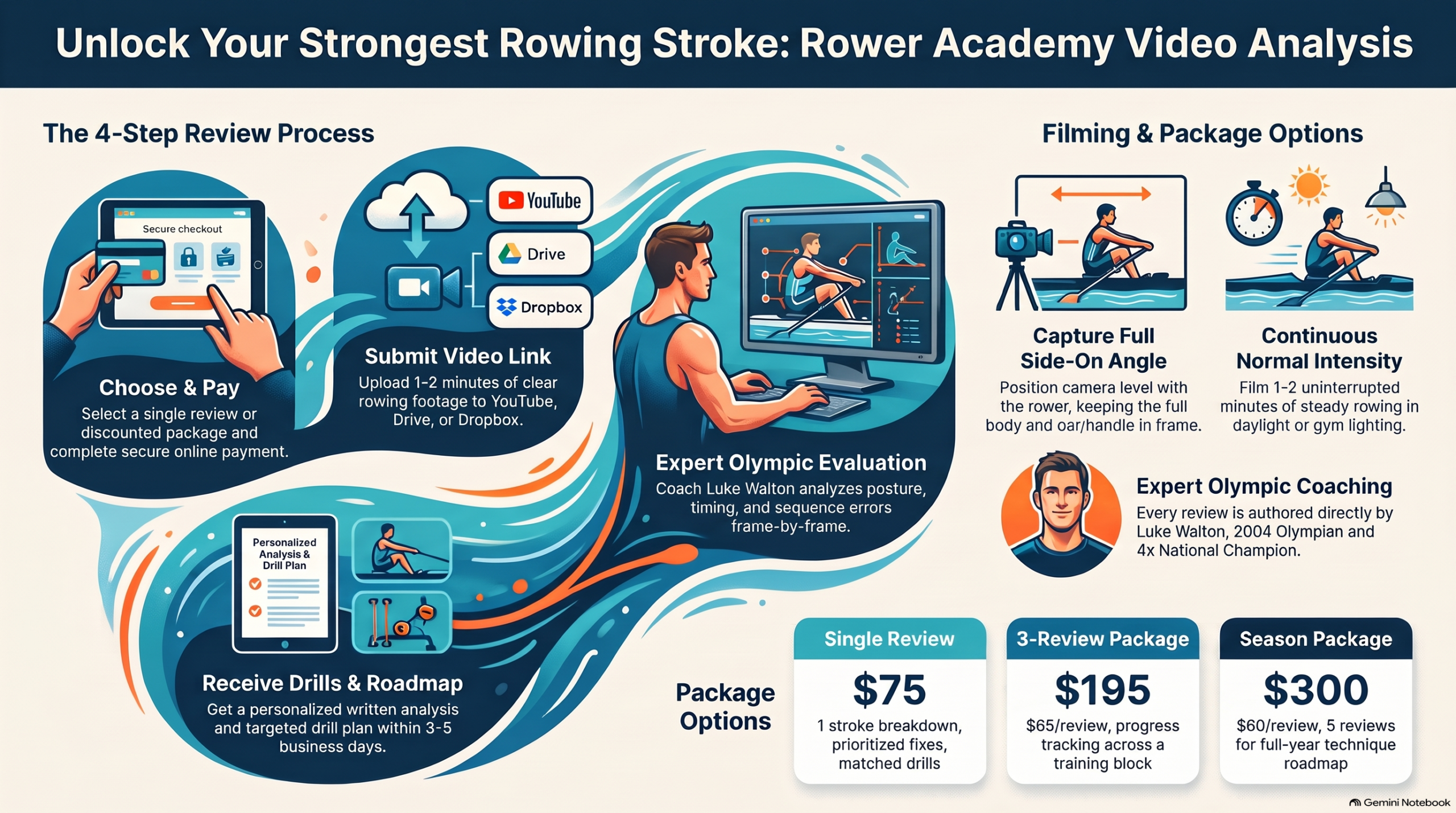
Fix My Rowing Form is Rower Academy’s personal video stroke analysis service. The idea is simple:
- Film 1–2 minutes of your rowing — on the water or on the erg.
- Share the link (YouTube unlisted, Google Drive or Dropbox).
- Get a detailed written review in your inbox within 3–5 business days.
No templates. No automated scoring. Every review is written personally by Coach Luke Walton, OLY.
Who Reviews Your Stroke
Your footage isn’t passed to an algorithm or an assistant. It’s studied by Luke Walton, 2004 U.S. Olympic rower (Athens).
- Member of the US National Rowing Team, 1999–2003
- Undefeated collegiate career at UC Berkeley (1998–2001) — never lost a heat, semi-final or final, winning four straight PAC-10 and National Championship titles
- Named to the PAC-12 All Century Rowing Team
- Rowed for Cambridge University in the Boat Race in 2005 and 2006
Since then, Luke has spent decades in launches and erg rooms teaching juniors, masters and university squads the same stroke he rowed as an Olympian. Sweep or sculling, a single through an eight, any make of indoor rower — he reviews it all.
What You Get in Every Review
1. Stroke Segment Analysis
Your stroke is broken down phase by phase — catch, drive, finish and recovery — looking at sequencing, how you apply power, posture and timing.
2. Prioritised Corrections
Not a list of twenty faults. You get the two or three changes that will actually move your boat, ranked in the order you should work on them.
3. Drills That Reinforce the Fix
Every correction comes with specific drills, cues and points to focus on — so you understand both the how and the why of each change.
A Real Example
Here’s the kind of feedback you can expect:
Fault (Catch): Shins not reaching vertical, not achieving full compression.
Correction: Let the seat roll further into the front end while keeping proper posture — shoulders in front of hips.
Drill: Legs only. Stay upright and forward, and exaggerate the roll into and through the front end of the stroke.
Why: If you only roll to half slide on the recovery, the best you can achieve on the drive is a half-slide stroke. Floating long and freely into the front end gives you the longest drive possible and lets you fully use your legs — your strongest muscle group.
That’s the difference between “use your legs more” and a fix you can take to your next session.
Who It’s For
- Masters rowers who train without regular coaching
- Indoor rowers chasing a new personal best on the erg
- Juniors and college athletes who want an edge before selection or trials
- Scullers and sweep rowers who feel their boat isn’t running as it should
- Coaches who want an expert second opinion on an athlete
If you’ve ever thought “I know something’s off, I just don’t know what” — this is for you.
Simple, Transparent Pricing
| Package | Price | Best for |
|---|---|---|
| Single Review | $75 | Finding what’s holding you back right now |
| 3-Review Package (most chosen) | $195 ($65/review) | Working one fix at a time across a training block, with progress compared against your first video. Use within 6 months. |
| Season Package | $300 ($60/review) | Five reviews, mixed on-water and erg footage, a season-long technique plan and priority turnaround |
Payment is handled securely through PayPal.
Tip: Technique changes stick when they’re checked. The 3-Review Package lets Luke confirm your fix has held — and update your drill plan as you improve.
👉 Choose your review package at FixMyRowingForm.com
How to Film for the Best Review
Two minutes of care here gets you a much sharper analysis:
Do: – Film 1–2 minutes of continuous rowing – Shoot side-on, with the camera level with the rower – Keep your whole body plus the handle or oar in frame throughout the stroke – Hold the camera steady (tripod, rigger mount or a still friend), in landscape, in good light – Row at a rate and pressure you actually train at
Avoid: – Short clips or several takes stitched together – Head-on or from-behind-only angles – Zooming, panning or walking while recording – Backlit or heavily shadowed footage – Private links with sharing turned off
Want to Work With Luke Directly? Try 1:1 Coaching
If you’d rather work on your form and fitness in real time, Coach Walton also offers one-on-one online coaching. It’s ideal for rowers training toward a specific race, a personal-best goal or a return to the sport.
To get started, email Luke and tell him where your rowing is now and where you want it to go:
Your Next Stroke Could Be Your Best One
Every session you row with a hidden fault, you’re reinforcing it. Every session you row with the right fix, you’re building speed that lasts.
Grab your phone, film two minutes, and find out exactly what’s holding you back — from someone who has raced at the Olympic level.
Submit Your Video for Review — From $60 per Review →
Prefer personal coaching? Email Luke about 1:1 coaching.